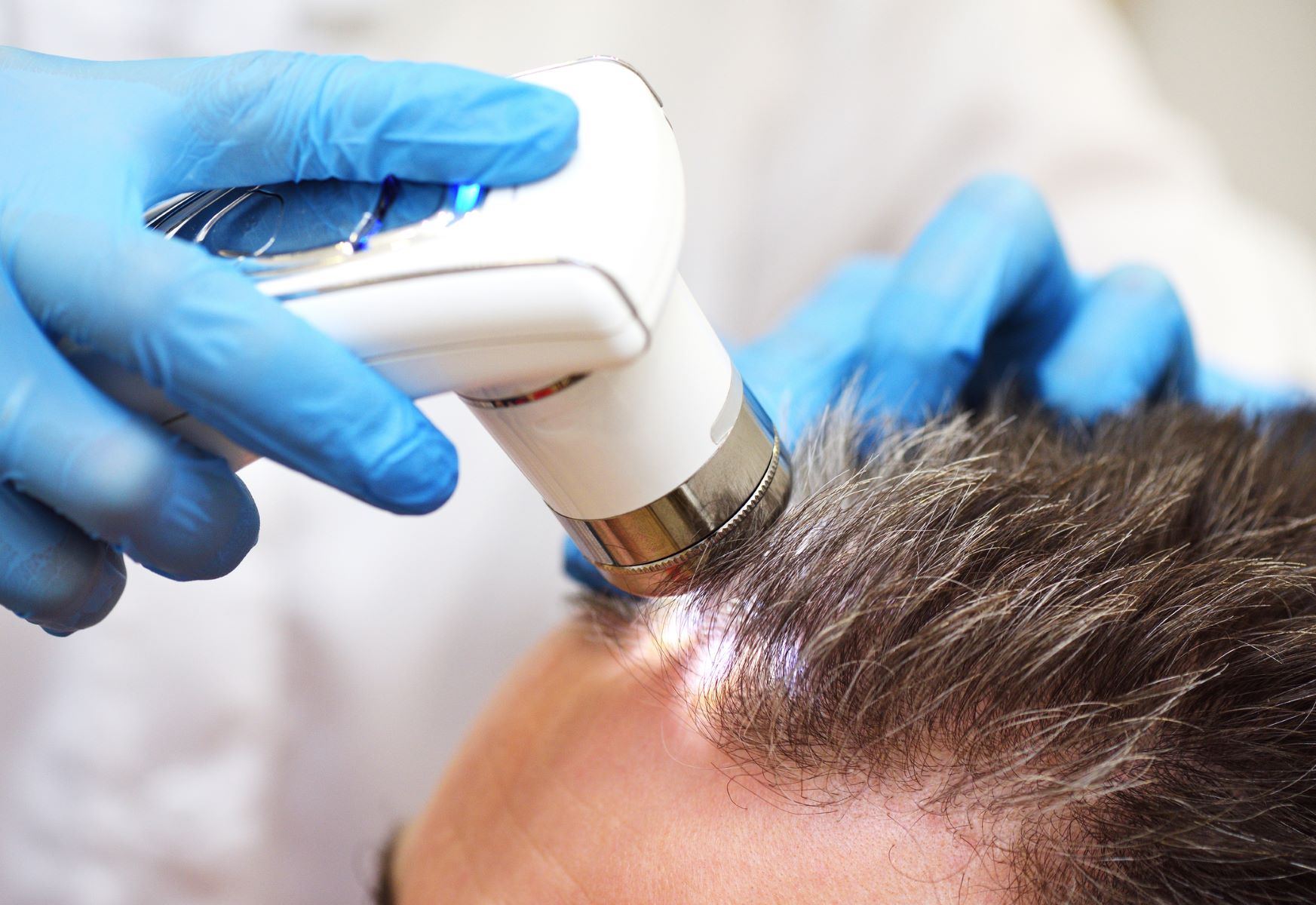
When too much DHT is produced or your hair follicles are particularly sensitive to it, this male hormone can bind to specific receptors in your hair follicles, causing them to shrink. When this happens, you will experience hair miniaturisation on the affected scalp areas (usually the hairline, temples and crown). If left untreated, this normally progresses to fully-fledged balding.
Finasteride helps lower the DHT levels in your blood (or, if you are using topical Finasteride, in your scalp). This can curb hair loss and restore hair growth in male pattern baldness, especially if diagnosed early.
Sometimes, post-menopausal women can also use Finasteride off-label for female pattern baldness. However, it is not normally recommended for premenopausal patients, as it can cause birth defects and hormonal imbalances [4].
Does Finasteride Expire?
Yes. Like all commercially available medications, Finasteride can expire if not used within a specific timeframe from the moment it was produced. The manufacturer is responsible for listing the expiration date on the drug packaging.
What does the Finasteride expiration date mean?
The Finasteride expiration date represents the last day in which the manufacturer can guarantee that your medication is still effective for its intended purpose. That doesn’t necessarily mean they can guarantee Finasteride will make your hair grow back, as this is determined by many factors. It simply means that the pharmacological properties of the drug will remain unaltered up to this date.
Like all medications, Finasteride starts slowly losing some of its potency over time from the moment it is produced. The drug can spend several months on the pharmacy shelf before it’s purchased, and may not be used immediately afterwards. Expiration dates are needed to ensure Finasteride is still fully effective when you decide to use it.
When does Finasteride expire?
In general, Finasteride tablets have a relatively long shelf-life if stored appropriately. Some Finasteride tablets can be used for 4 years before they expire [5]. However, some expiry dates are as soon as 36 months from the date of production, as manufacturers want to ensure it is used at peak effectiveness [6].
If you can’t find any expiration date on your Finasteride packaging, ask your pharmacist for this information. If this is not an option, as a rule of thumb, it is generally safe to use Finasteride for 12 months after purchase.
Can I still use expired Finasteride?
Medical professionals recommend against using any medication, Finasteride included, after its expiration date. That is because it can be less effective, possibly leading to worsened hair loss or a curbed hair regrowth progress.
However, there is no evidence that using expired Finasteride for hair loss will cause any physical harm. So if you happen to take some expired Finasteride by accident, there’s no need to worry about serious adverse effects on your health.
Signs that your Finasteride may have expired or gone bad
If you’re unsure if or when your Finasteride expired and are concerned that it may have been compromised by heat, moisture or any other cause, check for these signs:
- Tablet discolouration – the leaflet will normally specify what colour your tablets are supposed to be. If your white tablets have turned yellowish/brownish or your coloured tablets have faded or changed shade, they may be compromised.
- Tablet consistency – your Finasteride tablets may be softer or crumble more easily than usual.
- Topical medication consistency – your topical Finasteride may become either thicker or more watery than usual, depending on its form.
- Topical medication smell – your Finasteride gel or solution may develop an unpleasant or unusual odour.
If you notice any of these signs or have any other reason to believe your Finasteride may have expired or gone bad, the safest thing you can do is to dispose of it.
Can using expired Finasteride make my hair fall out?
Expired Finasteride can be less effective against androgenetic alopecia. So while the drug itself is unlikely to cause your hair to fall out, you may experience more severe hair loss as a result of using a less potent treatment.
Also, be aware that male pattern baldness can progress if treated with ineffective medication. This can make hair growth more difficult to achieve in the future. If your condition becomes too advanced, you may require a hair transplant to restore your full head of hair.
Can poor storage make Finasteride expire faster?
Poor storage can’t technically make Finasteride expire, only time can do that. But it can damage the medication, reducing its effectiveness and/or potentially rendering it dangerous for human consumption (for example, if it is exposed to mould or harmful bacteria). So it’s best to store your Finasteride appropriately, to maintain its properties and effectiveness for its entire shelf life.
How to properly store your Finasteride
If you want to make sure you will be able to get the most out of your medication, it is a good idea to respect the following storage instructions often found on its leaflet [7][8]:
- Keep your Finasteride tablets in their original container. Don’t remove them from a blister pack before it is time to take them.
- Store your Finasteride in a cool, dry place, out of the sun (make sure the temperature doesn’t rise above 30°C).
- Avoid leaving your medicine in the car or on window sills, as temperatures may rise unexpectedly.
- Dampness can damage your Finasteride tablets so avoid leaving an open medication bottle on the sink or in a steamy bathroom.
- Keep your Finasteride out of the reach of children and pets.
- If there are pregnant or breastfeeding women in your household, warn them against handling your Finasteride. Also, clean any medication residue off surfaces after use and throw away napkins used to wipe off excess topical solution.
How to safely dispose of expired Finasteride
If your Finasteride has expired, become compromised by heat or water, or you simply no longer need it anymore, don’t throw your tablets in the bin or flush them down the toilet. It’s best to take them to the nearest pharmacy to be disposed of safely.
Medications improperly disposed of can make their way into the water supply, causing detrimental health effects for people and wildlife alike. However, any pharmacy in the UK will accept and safely dispose of your unwanted medication, even if purchased elsewhere.
Does Minoxidil expire sooner than Finasteride?
Minoxidil and Finasteride have similar shelf lives: approximately 3 years. However, always check the expiration date on the packaging when comparing products.
Some of the most widely used brands, such as Rogaine , have a shelf-life of 3-4 years. For oral Minoxidil, the Electronic Medicines Compendium (EMC) reports a shelf life of 3 years [10].
The EMC shows different Finasteride tablet formulations and concentrations also expire between 3 and 4 years. For example, the popular Finasteride brand Propecia (Finasteride 1mg tablets) is listed with a 36-month shelf-life [12]. Research shows that the shelf life of Proscar, a prostate medication containing Finasteride 5 mg (which may sometimes be prescribed for hair loss), can exceed 2 years under proper storage conditions [11].
This table compares the shelf-life of specific Minoxidil and Finasteride 1 mg products according to the EMC:
| Minoxidil shelf life | Finasteride shelf life |
- Regaine for Men Extra Strength Scalp Foam 5% w/w Cutaneous Foam – 3 years
- Regaine for Men Extra Strength Scalp Solution 5% w/v Cutaneous Solution – 3 years
- Axunio Pharma Minoxidil 5% w/v cutaneous spray, solution – 30 months (or 1 year after opening)
- Regaine for Women Regular Strength – 4 years
- Regaine for Women Once a Day Scalp Foam 5% w/w Cutaneous Foam – 3 years
- Minoxidil 5 mg Tablets – 3 years
| - Propecia 1 mg Film-Coated Tablets – – 3 years
- Aurobindo Pharma Finasteride 1 mg film-coated tablets – 4 years
- Mylan Finasteride 1 mg film-coated tablets – 3 years
- Amarox Finasteride 1 mg film-coated tablets – 3 years
- Proscar 5mg film-coated Tablets – 3 years
|