Is expired Minoxidil safe to use?
The FDA advises that you shouldn’t use any medications past their expiry date. They may be less effective, and there could be an increased risk of side effects.
Out of date medications may have changes to their chemical composition [9], or they could be at risk of bacterial contamination, depending on how they’ve been stored. If your Minoxidil is out of date, you shouldn’t use it [9].
What happens if you use expired Minoxidil?
Several things may happen if you use expired Minoxidil. For one, it might not work as well, if it works at all. The FDA advises that expired medications can be less effective or more risky due to chemical changes or a decrease in potency [9].
In some cases, a drug past its expiry date may contain toxic compounds, which can increase your risk of experiencing side effects [10]. Furthermore, FDA approval is based on using a product that has not expired.
The FDA completes thorough testing to ensure medication is safe to use, but they don’t guarantee safety when it goes out of date. If in doubt, throw it out.
How should you store Minoxidil?
Minoxidil should be stored at room temperature. Keep it upright and protect it from direct sunlight. Your Minoxidil may expire sooner than its “best before” date if you leave it in a hot room, stuffy car or sunny shelf.
How do you know if Minoxidil has gone bad?
If your Minoxidil has gone bad, there might be some changes to its smell, texture or colour. It’s possible for Minoxidil to become unusable before its expiry date if it’s not stored properly.
If you start to experience side effects from the Minoxidil you’re using, particularly if you normally use it with no problems, this may also be a sign that there’s a problem with the medication. In addition, it may have lost its potency if you’re not seeing any improvement in your hair growth.
If something doesn’t look right, don’t use the Minoxidil. Seek medical advice if you are experiencing side effects or the medication isn’t working as it should.
What to do with expired Minoxidil
The best thing you can do with out of date medications is to return them to a pharmacy for disposal. It can be tempting to chuck your old Minoxidil in the bin or flush it down the toilet, but unfortunately, these options aren’t safe for the environment or other people.
If you throw Minoxidil in the bin, it could be found by people or animals who shouldn’t use it. If you flush expired medication, it could pose a risk to the environment [11].
Alternatives to Minoxidil
Minoxidil is one of several effective treatments for male and female pattern baldness, as well as other hair loss conditions. Here are some other treatments that may help if you’re experiencing hair loss.
Finasteride
Finasteride is another medication used for male pattern baldness. It’s not licensed for female pattern hair loss but is sometimes prescribed off-label to postmenopausal women. Finasteride reduces dihydrotestosterone (DHT) levels in your body, slowing down hair loss and promoting hair growth.
Like Minoxidil, Finasteride does expire after a few years. Learn more about Finasteride expiry.
Low-level laser therapy
Low-level laser therapy (LLLT) involves aiming light of specific wavelengths at areas of hair loss on the scalp. This treatment can stimulate hair growth in both men and women with pattern hair loss [12].
PRP hair treatment
PRP hair treatment is a type of regenerative medicine. Platelets from your own blood are injected into areas of hair loss on your scalp, stimulating hair growth. This treatment can also be combined with a hair transplant to improve outcomes [13].
Hair transplant
A hair transplant is the gold standard treatment for male pattern baldness. It can also help with other types of alopecia, such as hair loss from trauma, burns, or surgery, and traction alopecia in some cases.
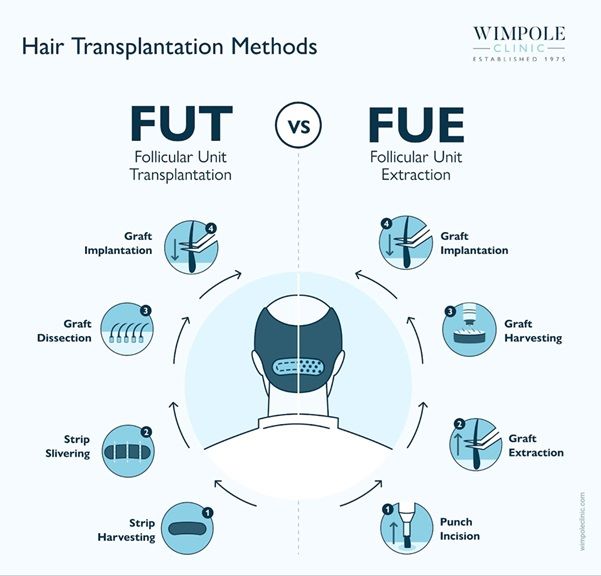
There are two main types of hair transplant: follicular unit extraction (FUE) and follicular unit transplantation (FUT). Both types of transplant involve moving healthy hair follicles from an area of healthy growth to areas of hair loss.
FUT and FUE differ in how the hair follicles are harvested. With FUE, follicles are harvested using a micro punch tool, which leaves tiny, near-invisible circular scars on the hair transplant donor area (usually the back or sides of the scalp).
With FUT, a strip of skin containing multiple hair follicles is removed from the donor area. This allows large amounts of hair to be transplanted but leaves a hair transplant scar at the back of the scalp. Sometimes, this scar is disguised with a second, more minor, FUE procedure.